Time
As 2026 begins, I invite you to discover the true essence of Time in just a few minutes...

I said to my soul, be still, and wait without hope
For hope would be hope for the wrong thing; wait without love
For love would be love of the wrong thing; there is yet faith
But the faith and the love and the hope are all in the waiting.
So the darkness shall be the light, and the stillness the dancing.
- T.S.Eliot, Four Quarters, East Coker
At the end of every year, I always think about one thing—Time.
How our experience of a beginning and an end has shaped our human experience.
From religions that start with a divine act of creation and end with a judgement day, to growth metrics used by companies to assess performance, to how much we learn, earn and how long we live, Time has been our ruler since we became conscious beings.
As 2025 came to an end, I felt it was time to tie up all the different strands I have shared on this series on Light with a story about Time. A story that started with Fear.
Fear is a primal emotion that has many forms —fear of loss, death, or missing out—which determines nearly all our actions and sets limits on our full potential. It is an ancient trait which helped us hoard food or flee from the predator in the bush to survive but it now hinders us from becoming our true selves. Because when we let go of Fear, we, the river, as Gibran’s poem told us, can become an ocean.
Similarly, our senses limit the full spectrum of reality that is possible to experience. They become more and more refined by evolution to help us in this game of survival, but increasingly restrict us from truth. We know this by looking at other animals, even trees and plants, who experience different slices of the same objective reality. Stitching all of these different slices gives us the full spectrum.
I asked the reader, what would we discover if we could see, hear, smell, touch and taste the ocean, and not just be satisfied with the river.
We discovered the answer has always been right in front of us — Light.
Light comes from stars which fuel the cycle of life on Earth and when they die seed life in other parts of the universe. We are also made from it, each of the elements from stars are also what our bodies are composed of — this is scientific fact, not spirituality or metaphysics, as my previous posts explained in detail.
We are born from the death of stars long ago, and when we let go of the Fear, we can be Light again.
We also discovered that Language places a self-imposed restrictions on what we can describe, discuss and articulate. In turn Language fine-tuned our evolution further to see the world is a specific way. We simply do not have the perspective or the words to describe objective reality and hence the full spectrum of Light.
Our paranoid and schizophrenic relationship with Time – in which we need to break it into smaller units to derive more value from each unit, and then we put ourselves in a state of stress by chasing down each of those units to attain maximum productivity – is a testament to our greater sense of mortality. We know our time on this Earth is finite, so we must make every second count.
Our experience of Time is that of a linear phenomenon—we are given a specific length of existence, things happen one after the other, and we strive to fight against Fate to shape our reality into our desired outcomes, before time runs out.
This is the story of all humans. But what if we have misunderstood Time because we simply exist within it, much like we do with Light and its multitudes. What if we changed our perspective on the nature of Time? How would that change our perspective on everything else?
Does it not feel like we are repeating the errors of the past, watching the world head towards a slow motion car crash but unable to stop it? I get this feeling all the time, and I always tried to understand why we do this as a species. Why can’t we collectively learn from the mistakes of our ancestors — is it in our DNA or is it in our relationship with things we take for granted, such as Time.
Let us try to redefine Time in the next few minutes of reading and reflection to see if we can change our perspectives.
For most of human existence, Time was experienced as a continuous, cyclical flow. That was until the invention of clocks in the town square, which were eventually miniaturised into your pocket and onto your wrist. Even in the days of sundials and hourglasses, Time was not kept but only its flow was measured. People lived by the flow of daylight, divided into watches by the Romans – not the physical things on your wrists but the guys who looked out for enemies in the distance.
Initially watches were divided into two (before and after noon), then eventually into multiple watches in accordance with the sundial. Christian monks further decompressed this flow into a rigorous schedule of prayers in the latter half of the Middle Ages. Since 1967, the International System of Units has defined a second as the vibrations (or oscillations) of caesium atoms. Caesium-133 was chosen because it has a very consistent and measurable resonance frequency that is unaffected by most environmental factors.
Thus, through the advances of science, we have refined Time from the flow of nature to become one of quantum nature. Step by step we have broken it down, given it more and more boundaries. With this decoherence of time, we have shaped our lives around the vibration of a single atom.
We have lost the flow of Time as a fundamental ingredient of the universe.
With this evolution of Time, we have begun to misunderstand it, because we treat it as an independent dimension, when it is really the story of the transformation of energy.
Increasing entropy—a universal law that explains why an omelette does not become an egg or the cream does not separate from the coffee—inside a spacetime reshapes that energy into different forms which our brains decipher as Time passing.
The brain does not experience the world in real-time. It creates a tapestry of narratives from sensory delayed inputs, fractured memories and best predictions — which collectively creates a consciousness.
Every moment you feel of Time passing is actually a mili-second integration window of those actions that the brain blends into a smooth feeling of now. This means Time, as we experience it, is an emergent cognitive construction—not a physical entity flowing outside us or through us.
Emergence can be found everywhere in nature and in the universe.
In physics it occurs where complex behaviours or properties arise from the interactions of simpler components, that do not exist within the individual components themselves. It is a fundamental concept in understanding how macroscopic phenomena emerge out of microscopic interactions.
Wetness is a good example.
A single H2O molecule is just a microscopic structure made of two hydrogen atoms bonded to one oxygen atom—it isn’t ‘wet’ in any meaningful sense. Even a small cluster of water molecules doesn’t display what we perceive as wetness. However, when billions upon billions of these molecules come together, their collective interaction creates the familiar property we know as wetness—the ability to stick to surfaces, form droplets and flow as a liquid.
This emergence happens because of the hydrogen bonds between water molecules and their interaction with other materials, creating surface tension and adhesion that give water its characteristic ‘wet’ behaviour. This property then becomes useful, allowing for other emergent phenomena to take place such as the emergence of complex life within its environment.
The essence of emergence is that the whole is greater than the sum of its parts – new properties emerge at a higher level of organisation from the interaction of simpler components at the lower level.
This is what Time is. It is also emergent.
If Time didn’t appear to flow then memory could not be formed, intention could not exist, identity would dissolve, perception would be meaningless.
Time provides the scaffolding for all conscious life to emerge.
Without Time, there is no self.
Without self, there is no awareness.
Without awareness, there is no world to inhabit.
Time is the movement from low entropy to high entropy. From stasis to movement. From order to disorder. From mass to energy.
Time’s arrow emerges from entropy increasing. But the human brain doesn’t directly sense entropy. Instead, it interprets this as change.
Consciousness and Time are therefore co-emergent: you can’t have one without the other.
The brain continuously stretches and compresses our personal timeline to create structure and meaning. Events that feel important are expanded. Events that are repetitive are compressed or automated. Your neurons convert chemical messages into patterns or actions is entropy increasing.
We convert physical entropy into psychological Time.
Our arrow of time, therefore, is simply our way of understanding and sensing entropy.
The question that we should be asking is what would we feel if we stepped outside the sense—perhaps this is our sixth sense—of Time?
In spacetime, all events exist at once. This is Light in its purest form, where there is no arrow of time, nor individual consciousness.
Without consciousness, the universe would be simply an infinite tapestry of awe.
With consciousness, the tapestry becomes a movie—structure emerges.
Without Time, there is no structure.
Without structure, there is no reality.
The universe gives us entropy. The brain gives us Time.
The interaction between the two gives us our reality.
We arrive then at a conclusion of sorts.
Time is not a clock.
Time is meaning.
But one last question remains—what is meaning?
Does Time give us meaning, or does it restrict us from the true meaning of Light?
To me, it does both.
After all, many aspects of the nature of the universe are based on duality—it is the only way emergence can occur.
Now that we have explored the nature of Time, ask yourself—what meaning will you give yourself for 2026?
One of the most meaningful moments for me last year was publishing my book, The Emergence of Awe, with independent publisher Tandem Publishing, that explores these themes of flow, time, entropy and emergence.
If you liked this series, I hope you will find something more meaningful for you in the book as well.
Thank you for all of those who subscribed to my substack this year, it means a lot to me and encourages me to explore further and share my writings wider. If you haven’t subscribed yet please drop your email here so you can continue to receive my work in 2026.
Wishing you a meaningful New Year!
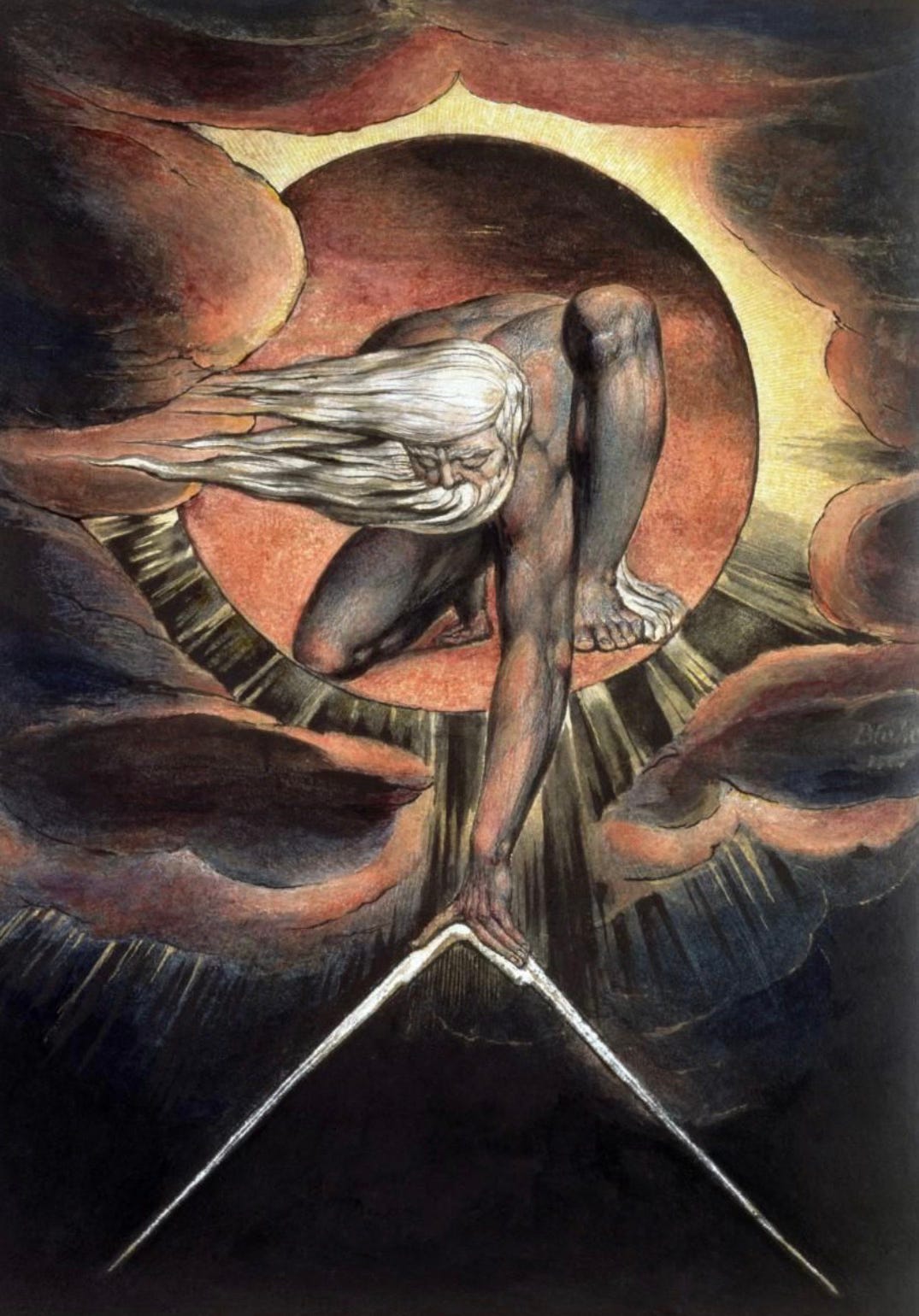
I started this post with one of my favourite poems and will leave you with a question about one of my favourite paintings.
Time is most certainly emergent, I agree with how elegantly you extrapolate that.
However the Self is an enduring, non linear concept that stretches beyond time - consciousness is not dependent on time emerging.
Consciousness is known as “Brahman” or totality in the Vedic wisdom tradition. The ultimate force of creation in the universe. Nothing can exist without consciousness.
The impersonal totality consciousness Brahman is infinite and all pervasive irrespective of human consciousness. We are emergent from this and so there is no separation between us and it.
In other words, the little me self (I) is bound by time in the sense that “I” am an emergent phenomenon at a point of time. I today have emerged from the Self - as I emerge, I am an expression of the Self observing itself.
Like a wave rising from the ocean. As we exhaust our “time” on the planet in this physical form (governed and bounded by “time”) - we collapse back into the Self. The wave becomes indistinguishable from the ocean again, and so on and so forth.
Consciousness is not linked to time - in the sense of the Self (Brahman).
What is linked to time is simply the Emegence of our little selves & the consciousness we experience as inhabitants of this physical form for a brief period.