Light
and its multitudes

“There is that in me—I do not know what it is—but I know it is in me.
Wrench’d and sweaty—calm and cool then my body becomes,
I sleep—I sleep long.
I do not know it—it is without name—it is a word unsaid,
It is not in any dictionary, utterance, symbol.
Something it swings on more than the earth I swing on,
To it the creation is the friend whose embracing awakes me.
Perhaps I might tell more. Outlines! I plead for my brothers and sisters.
Do you see O my brothers and sisters?
It is not chaos or death—it is form, union, plan—it is eternal life—it is Happiness.
The past and present wilt—I have fill’d them, emptied them,
And proceed to fill my next fold of the future.
Listener up there! what have you to confide to me?
Look in my face while I snuff the sidle of evening,
(Talk honestly, no one else hears you, and I stay only a minute longer.)
Do I contradict myself?
Very well then I contradict myself,
(I am large, I contain multitudes.)”
- extract from Song of Myself (50-51), Walt Whitman, 1892.
In my last post, I shared a poem I had written but did not give it a title.
This was because I wanted the reader to experience meaning between words.
Each stanza carried a deeper layer, some of which you drew out.
Meaning that may be universal or may only resonate with yourself.
But at its heart, the poem was about something simple—Light.
I am glad you read in between the layers of its simplicity.
It is the same with Light itself. It has many layers. It has multitudes.
The seas turn cold and winds take its place when the Sun looks away. Trees grow upwards to steal the Sun’s attention, but when it’s gone they start communicating with each other to share resources through their roots.
Light illuminates, providing us with sight but also with our sense of time - be it a day, a year or a season. Its absence feeds our fears, and darkness absolves us of meaning.
Even the speed of light shapes our innate experience of time as we perceive distance and live within spacetime—any travel beyond 300,000km per second (which is the speed of light) will mean we can travel back in spacetime.
Light can be a wave and a particle at the same time.
Light can be entangled.
Light can be you.
The Sun and our bodies are made of the same fundamental particles and elements, born in earlier stars that lived and died long before our solar system existed. When those ancient stars exploded as supernovae, they seeded the universe with heavier elements that later formed the Sun, Earth, and eventually us.
The main particles and elements we share with the Sun are listed below — proof that we are literally stardust:
Hydrogen (H): The simplest and most abundant element in the Sun (about 74% of its mass). It also makes up much of the water in our bodies (H₂O) and is a key part of organic molecules (nearly 9.5% of our structure).
Oxygen (O): The Sun contains oxygen, and in us it makes up ~65% of our body mass.
Carbon (C): Forged in the cores of ancient stars, and in our bodies (of about 18.5%), carbon is the foundation of DNA, proteins, and all organic molecules .
Nitrogen (N): Crucial for amino acids and nucleic acids in us; present in trace amounts in the Sun.
Calcium (Ca): Gives stars their spectral fingerprints; and in us, our bones and teeth.
Iron (Fe): Created in massive stars and spread by supernovae; whilst we use iron for haemoglobin to carry oxygen in blood.
Silicon (Si), Magnesium (Mg), Sulfur (S) and other trace elements: Found in the Sun’s spectrum and in Earth’s crust—in us, they play roles in enzymes, bones, and metabolism.
I wrote the poem about Light so that we, creatures made of Light and sustained by its layers—which provide us with sustenance and warmth, which feed the natural cycle of creation and destruction on our planet, which generate a sense of time so that we may experience the beauty it illuminates—can start to see the multitudes in the simplest things we take for granted.
So that we can start to see the multitudes within ourselves.
Between each word, between each act, between each feeling, there is something more profound.
Between the cracks—there is Light.
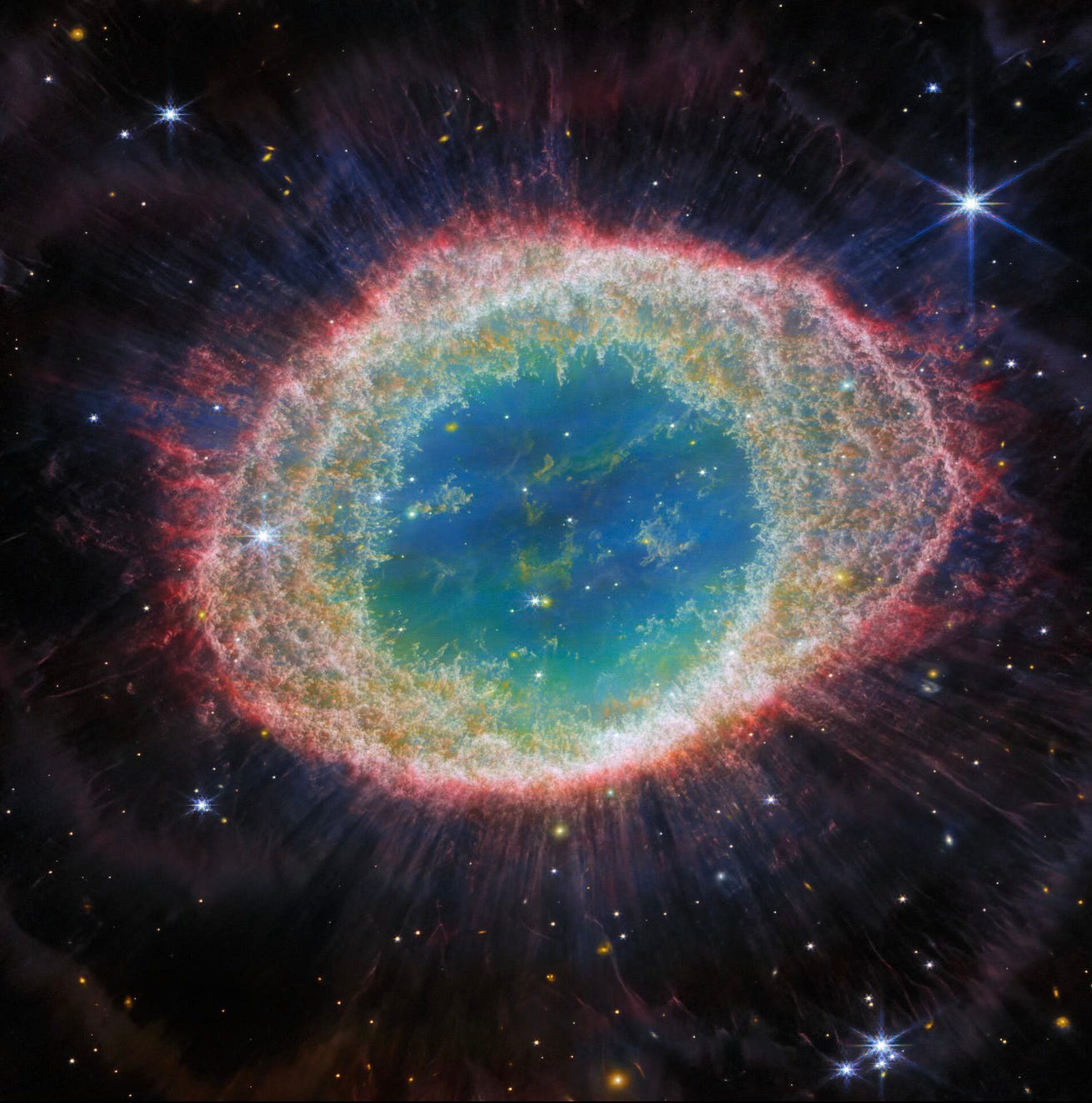
[the Ring Nebula, captured by the James Webb Space Telescope, showing glowing gas and dust expelled from a dying star]
Genesis 1:3, "Let there be light." It's not just an ancient story; it's a poetic explosion of wonder that weaves theology, physics, and philosophy into something timeless and intimate. In Genesis, God creates light on day one, but the sun and stars don't show up until day four.
Thinkers like St. Augustine didn't see this as a literal timeline, instead, it's a symbolic structure, a way to wrap the infinite in something we can grasp. The six days of creation aren't clockwork hours they're a literary embrace, turning primal chaos into order and life before our human sense of time even kicks in. And here's the poetic part: God exists in an eternal "now," outside time's rush. The Bible lays it out linearly just to meet us where we are, like a story told to a child, revealing a divine act that's all happening at once in the Creator's mind. Doesn't that make creation feel alive and immediate, like light is always breaking through the dark just for us?
Now, let's blend in some modern physics. Einstein would love how it echoes that biblical mystery. His theories of relativity flipped time on its head: it's not a fixed river but something relative, bending with speed and gravity. As you approach light's speed, time slows way down…imagine a photon, that particle of light, zipping across the cosmos since the Big Bang without aging a second. For light itself, time basically stops; it's timeless, eternal in its journey.
Then there's general relativity, where massive objects curve spacetime like a soft bend in reality, turning gravity into a gentle pull that warps our sense of past, present, and future. They're not separate lines but intertwined threads in a four dimensional tapestry. So, when God says "let there be light," it's like igniting the very framework of the universe…time emerging not before light, but because of it. It makes the stars feel like they're whispering secrets about forever.
Philosophically, this all ties into this enchanting idea of the eternal now, where time's just an illusion our minds play with. Mystics and philosophers have chased this for ages: past, present, and future coexisting in one shimmering moment, our awareness gliding through it like a dream. Genesis' non-linear description fits perfectly those "days" as phases of emergence, not a strict order, mirroring cyclical worldviews. It's like the universe is telling a non-linear tale, full of repeats and connections, inviting us to see our lives the same way. What if our choices today could touch yesterday's shadows or light up tomorrow's decisions?
This "let there be light" moment isn't a single spark in history it's the birth of spacetime itself, where light creates the stage for everything else. On a cosmic scale, it's divine geometry unfolding at the quantum level, photons carry that timeless spark like a hidden eternity in every ray. For us, it challenges our rigid view of time the finality of what's done, the distance of what's to come. Instead, it offers a deeper reality, our present actions can redeem the past, and eternity isn't some far off dream but something we touch right now, in light's warm glow. It's profound, isn't it?