Darkness
the 95% (a Halloween special)

Why are we afraid of the dark?
A place where our senses no longer shape our reality. A complete absence of the language of light and the letters of colour. A void. An emptiness.
Or is it?
We fear it because it is where we lose the narrative of our reality.
Our brain is a prediction machine that thrives on an internal narrative.
This ongoing conversation with itself helps it create stories which shape our world—a slither of the spectrum of true reality—that is calibrated with the limited information our senses can bring to give structure to this narrative.
Darkness, silence and stillness rob our brains of their ability to help us become more grounded in an objective reality that is too complex for us to survive in. And that is where imagination runs wild, that is where our dreams have no edges.
Perhaps the dark is where we can allow the boundaries of this spectrum to be pushed a little further—is it where the answers to our deepest questions lie?
Certainly, that is what most of the universe is made of.
Dark energy makes up about 68% of the universe, while dark matter accounts for approximately 27%, and normal, visible matter makes up the remaining 5%.
They are referred to as ‘dark’ because currently we have no idea how to explain them, but they exist—otherwise the laws of physics (as far as we understand them) would not work. This means the vast majority of the universe is composed of these two mysterious constituents that cannot be seen directly.
Without dark energy the universe would not be expanding as it is, and without dark matter the structure of galaxies and other clusters would not form. Dark energy is a form of anti-gravity pushing galaxies apart and dark matter is a form of matter that does not interact with light but has gravitational effects on visible matter.
Only 5% of the universe is made from matter that we can see and interact with—stars, galaxies, planets, humans, animals, computers and smartphones. The rest is darkness. And a lot of it.
As I tried to draw out in my previous posts, our reality is already compressed by our senses but expressed through the language of light. Yet darkness, is where true reality dwells.
Is this why we are so obsessed with the dark at this time of the year? We dive into the dark through our manifestation of fear—from horror films to Halloween costumes.
We celebrate it because perhaps deep down inside we know. We know that the darkness holds the key. It holds the answers to questions we cannot yet formulate.
These various forms of the unknown and undead in costume and festivities, are merely an expression of our awe of the dark. The spectrum of reality that we cannot see, hear, feel, taste or touch. The 95%.
Even within the darkest parts of space and the deepest levels of the quantum world—which we believed for so long to be a dead vacuum— there is life, a spark.
Here, the vacuum is actually filled with “quantum foam” — a restless bubbling of fluctuating energy, not a void.
These fluctuations are not just theoretical but have observable, real-world effects.
Particles and antiparticles are constantly appearing and disappearing in this “empty” space.
It is energy waiting to become matter.
Waiting to become reality—to broaden our spectrum just a little.
Waiting to become, a possibility.
A spark of life in an eternity of darkness.
_________________________
To go in the dark with a light is to know the light.
To know the dark, go dark. Go without sight,
and find that the dark, too, blooms and sings,
and is traveled by the dark feet and dark wings.
- Wendell Berry, To Know the Dark
_________________________
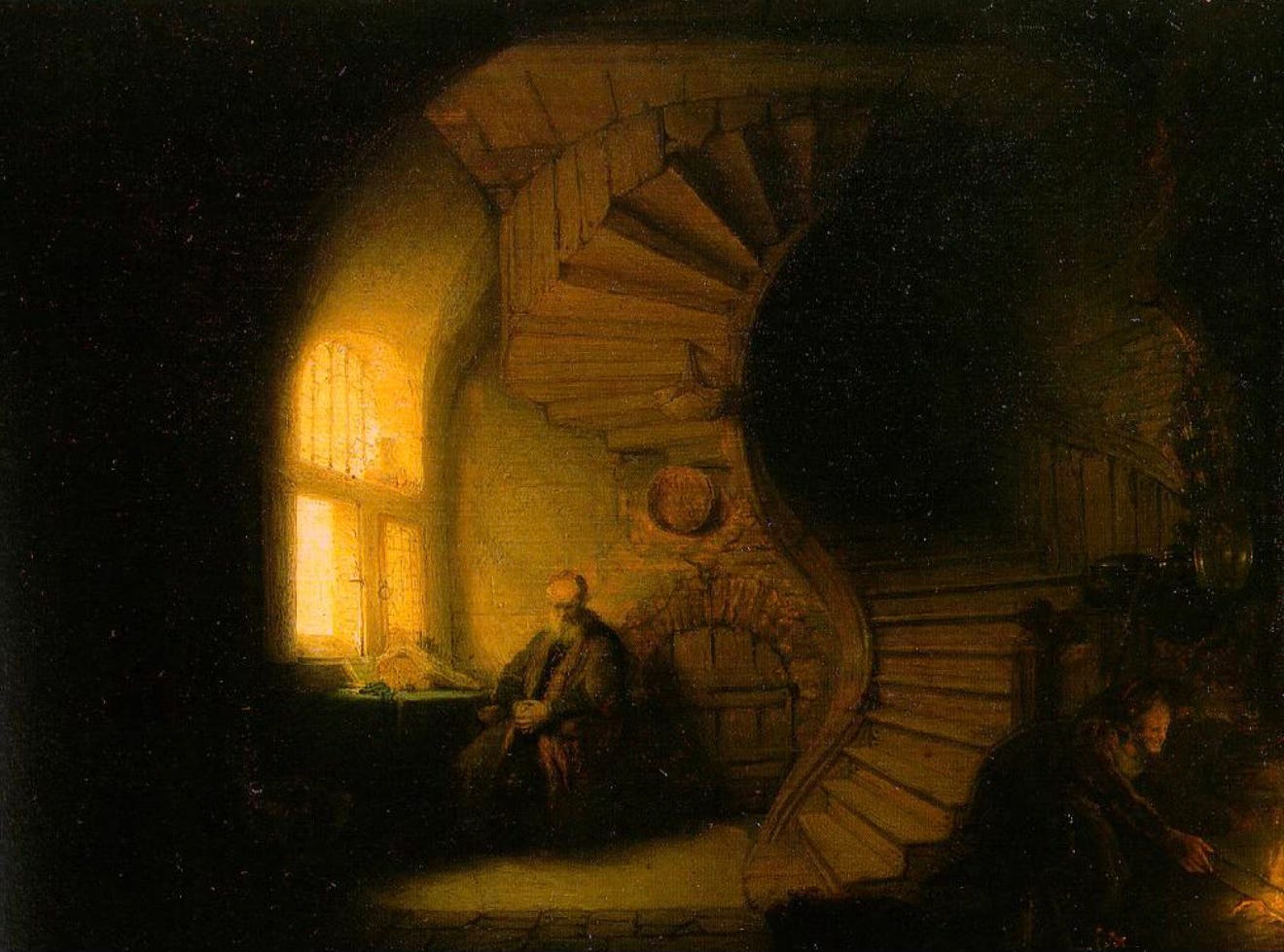
[Rembrandt’s Philosopher in Meditation]
_________________________
We live in a universe where 95% remains invisible to us dark matter and dark energy shape our cosmos, yet elude our detection. Like wind that we cannot see but can witness through its effects on swaying trees and rippling waters, these mysterious forces influence galactic rotation and cosmic expansion while remaining frustratingly beyond our direct observation. We call them "dark" not because they are black, but because we are quite literally "in the dark" about their true nature.
Remarkably, we carry this same mystery within ourselves. Neuroscientists tell us that approximately 95% of our brain's activity occurs below the threshold of conscious awareness. Your unconscious mind processes millions of sensory inputs, maintains your heartbeat, stores memories, and generates insights yet remains as elusive to direct observation as dark matter itself. Could this vast inner universe be our personal dark matter? Something that shapes our thoughts, emotions, and behaviors while remaining hidden from our conscious mind's detection?
This profound parallel echoes through Genesis 1:4: "And God saw the light, that it was good: and God divided the light from the darkness."
Here, God establishes the first polarity light and darkness, revelation and mystery. The Hebrew word for "darkness" carries layers of meaning: obscurity that obscures vision, and "secret place" a sacred space of the unknown. Light represents both energy and revelation, that which is made manifest.
Perhaps we're living in a universe of perfect symmetry: 95% cosmic darkness, 95% mental darkness. We are surrounded by forces that shape our reality while remaining hidden from view both in the vast cosmos above and the mysterious depths within. Our consciousness, that precious 5% of awareness, illuminates only a tiny fraction of what truly makes us who we are.
The universe continues to whisper its secrets, inviting us to seek, to question, and to marvel at what lies beyond our current understanding whether in the depths of space or the depths of our own minds.