Colours
and their secrets

Red, orange, yellow, green, blue, indigo, and violet.
What is their purpose?
They seem to not have any function other than distinction, but when we go beyond this spectrum each new form of colour is a wavelength with many functions.
We cannot see beyond red, but that is where radio waves (used for wifi, TVs and other devices), microwaves (used for heating and communication) and infrared (used in remote controls or red light therapy) reside.
We cannot see beyond violet, but here dwell some of the most creative and destructive waves. Gamma rays have the highest energy and shortest wavelengths, originating from nuclear reactions and cosmic events. X-rays are used in medical imaging to see inside the body. And finally ultraviolet is the UV from the Sun which can give you a tan or cause a severe burn.
These waves are all contained in a single photon. A single packet of light, or light quanta—as Einstein called it—pure energy directly proportional to the frequency it is tuned into. He won a Nobel Prize for this discovery, which created vast amounts of the technology we use today.
His discovery revealed something deeper. Light had frequencies and wavelengths which generated different structures or processes—just like how different frequencies of sound can generate a range of music and voices.
But why does red not have a superpower the way an X-Ray does? Maybe it does. Maybe it’s been hiding in plain sight all along.
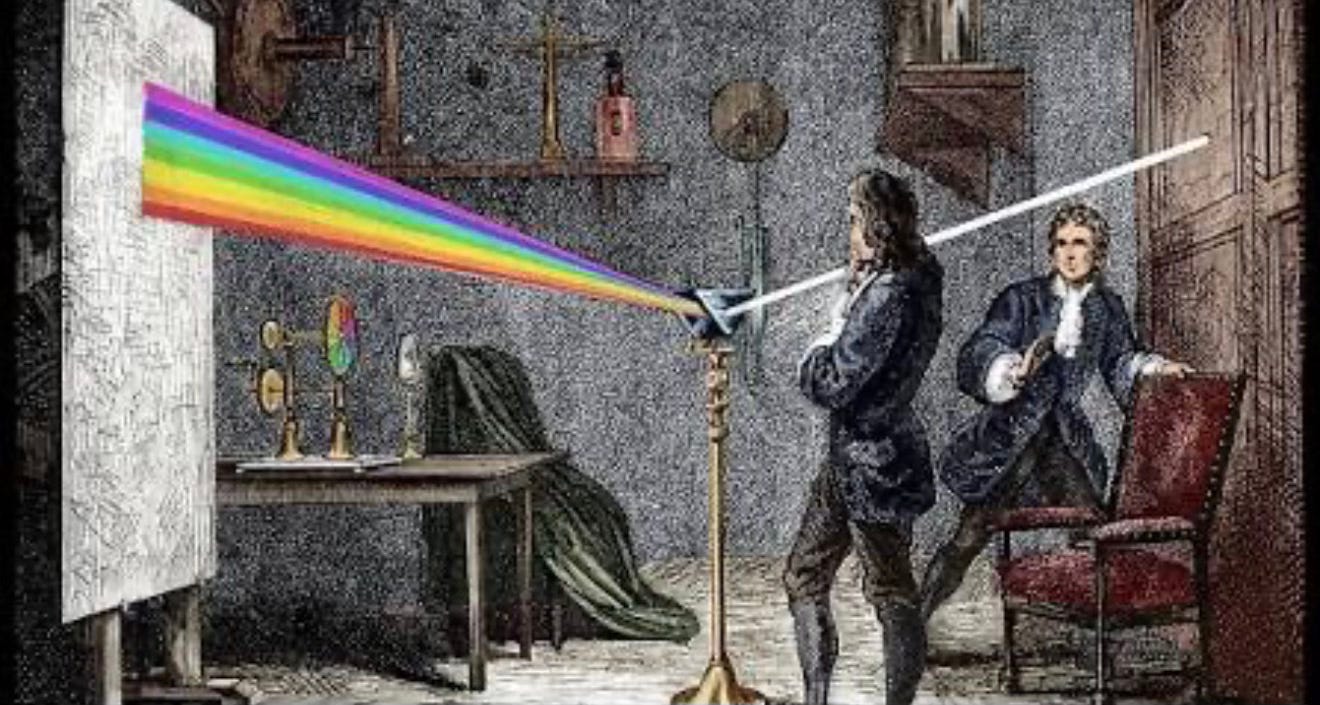
Sir Isaac Newton famously used a prism to refract a beam of sunlight, causing it to split into its component colours, showing the beautiful range we experience in this world are all contained in the Sun’s pure white light.
Interestingly, he also showed that these spectral colours could be recombined using a second prism to produce white light again. Newton’s experiments and theories established that colours are not just inherent properties of objects, but are the result of light interacting with matter.
The apple is not red, nor is the sky blue.
They are both emergent from the light of the Sun refracting from the many natural and unnatural prisms this world has to offer.
When white sunlight—containing all colours—hits a ripe apple, the apple’s skin absorbs all the wavelengths of light except for red. The red wavelengths are reflected by pigments called anthocyanin back toward our eyes, which perceive the colour red. Perhaps it chooses to be red because that colour attracts us and other species to consume it, and start a chain of reactions which fuels the cycle of life.
Similarly, as sunlight enters the atmosphere, blue and violet light is scattered in all directions, making the sky appear blue no matter where you look. Perhaps to help us find peace when the weather is calm and contrast it with the dark ominous clouds when a strong beckons to warn us.
The other colours, like red and yellow, continue on a straighter path, which is why the sun itself appears yellowish and the apple eventually appears red.
Light, therefore, contains not only information, but is a form of communication.
It is the language our reality uses to communicate with us.
To show us what to eat by absorbing the most radiant light and projecting it back to us to signal its nutritional value. To warn us when to take shelter when the blue sky starts to turn grey and black. To start our circadian rhythm when we absorb all the colours into our body from a single burst of sunlight. To show us the beauty of creation and the purity of its communication in the simplest form of white light. To help us feel the tides of entropy and decay as a phenomenon we call time (illustrated by Robert Frost’s poem at the end of this post).
The colours in our spectrum of reality give us something more special than any of the technologies we have created from the waves that reside beyond them.
Colours give us structure.
Colours are letters.
Letters of the language of light.
Nature’s first green is gold,
Her hardest hue to hold.
Her early leaves are flowers—
But only so for hours;
Then leaves subside to leaves.
In Autumn she achieves
A still more golden blaze
But nothing golden stays.
Of white, blue, gold and green,
The only colors seen
And thought of in the vast,
The gold is soonest past.
A moment it appears
At either end of years,
At either end of days.
But nothing golden stays.
In gold as it began
The world will end for man.
And some belief avow
The world is ending now.
The final age of gold
In what we now behold.
If so, we’d better gaze,
For nothing golden stays.
- Nothing Gold Can Stay by Robert Frost.