Brain Drain
A young maths genius's obsession and innovation will turn the tides of war, but her home will determine who the victor will be.

I was born just at the turn of the millennium in Kathmandu, Nepal. My parents had moved there from India to flee the violence between two different faiths, to raise our growing family of my seven siblings, four aunts, six uncles and three grandparents.
We lived in the outskirts of the city, in a town, where you could feel the past echoing in each footstep. I remember the mist that clung to the spines of the hills each morning, like shawls left behind by gods who had walked the ridgelines overnight. From my window in Kathmandu, the world unfolded in soft layers - terraced fields, fluttering prayer flags, the worn red bricks of shrines leaning into the past. At dawn, the city hummed with life and incense. My mother would smear a dot of vermilion on my forehead before school, whispering blessings that I never questioned.
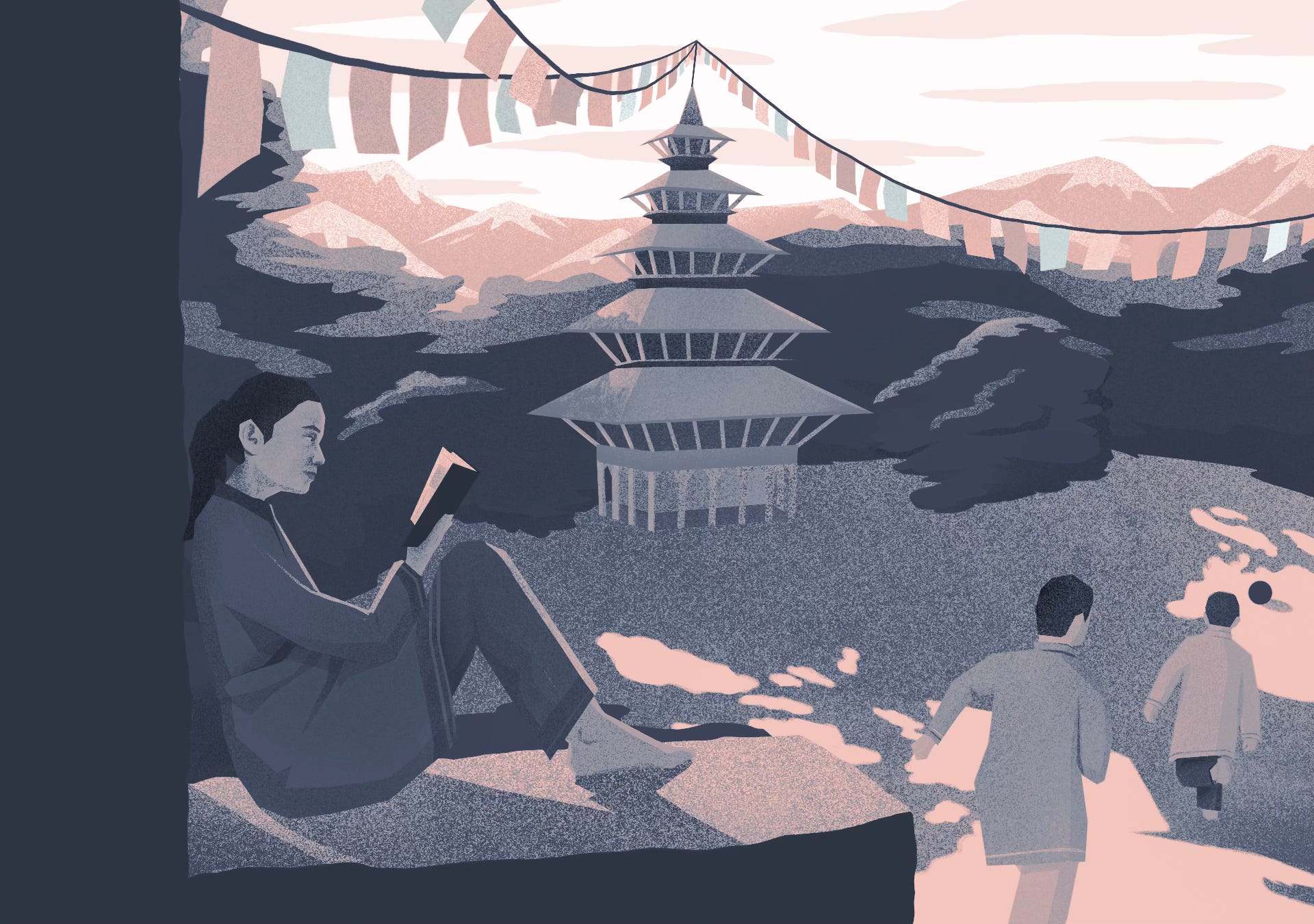
The clang of temple bells from Swayambhu Nath echoed through the valley like a heartbeat, steady and old, calling even the pigeons to prayer. The Himalayas loomed beyond, half-visible, half-imagined, like an ominous power waiting for us in a dream. I learned, without knowing it, that in Kathmandu, the divine lives not just in temples but in the spaces between - a crack in a stone, a whispered mantra, the slow, sacred fall of evening light on an old rooftop. I learned that the divine, the creative, came to you within the stillness of that chaos.
The scent of jasmine and sandalwood curled through the air like old verses - our house dim with the golden hush of early evening, when my grandmother would light the oil lamp before the altar. The flame would dance in the brass bowl, flickering shadows on the gods’ faces, as each verse flowed from her cracked lips into the trembling silence of our broken-tiled home. I would sit cross-legged beside her on the cool ground beneath me, listening to the chant of mantras like a river of secrets that I didn’t yet understand, but trusted. Slowly, my attention would turn to the outside world. As the cicadas called, I would watch the sun bleed slowly into the tamarind trees each night, inhaling a magic that did not need magicians.
There was too much beauty in the world. I wanted to find the hidden structure behind that beauty – so I looked for my religion elsewhere.
By the age of eight, my natural inclination for mathematics helped me win the prestigious region mathematics championship, and by the age of twelve I was the national champion. I prayed to these numbers every day, because they made me feel closer to something beyond the natural chores of life. There was no separation, interpretation, or tribalism in mathematics – only a pure truth, whose sole purpose was unification. Unification of disparate theories, conjectures and equations with a singular purpose of eternal harmony.
If there is only one God, is unification not its sole purpose too? But there are many religions, so how can there be many gods? There are not ‘many’ mathematics – only one – no matter what language you speak or flag you carry.
I could never understand why mathematics was not a religion. But then again, I never really understood people. I was a young girl living in a poor community, with no prospects in life, except for wherever these numbers would take me. I knew, even as a young girl, this was no place for me. My place was with my heroes.
My first mathematics teacher in school was my biggest inspiration, she saw early on that I was not good with words, or other children, or the other silly games and activities we had to partake in in school. I preferred to be in my own world, and I was only good at one thing. My teacher protected me from the bullying boys when I answered questions they couldn’t even understand, and she pushed me ahead when archaic teachers tried to hold me back. But I will mostly be thankful to her for introducing me to Johnny.
Johnny von Neumann.
Not everyone knew his name. They had all certainly heard of Albert Einstein, maybe even Niels Bohr, Edward Teller or Enrico Fermi. These men were gifts to the United States of America during World War Two. They were the real magicians.
They all had two things in common. They were the best mathematicians and physicists in the world – all contributing invaluably to the birth of quantum mechanics and were directly responsible for the technological superiority the country enjoyed for more than a century. Yet, none of them were born there. They ran or were chased away from their homes, haunted by a fear of persecution or simply because they did not want to be a part of fascist systems. These men were welcomed into the United States and brought together under one single purpose by J. Robert Oppenheimer. To save the world by building a bomb.
But Johnny was the best of them. He was my hero. Born in Budapest, Johnny’s inclination for mathematics was visible from the age of six as he showcased his dinner party trick of doing complex calculations for all his parents’ guests on the spot. He also won a national mathematics award, the Eötvös Prize, but not until he was nineteen. My father was quick to use this comparison at dinner parties. ‘Seven years older than when she won it,’ he would exclaim proudly, ‘and we have twice as many people here and a hundred times that in India!’
For me, there was no comparison, Johnny was unique. He saw patterns in everything, even beyond mathematics. He integrated pure and applied sciences with many fields, including physics, economics and statistics. He built the mathematical framework of quantum physics and for game theory, even devising nuclear deterrence as a geopolitical strategy for the cold war with the Soviet Union. But his most impactful work was in computing – he is the true father of what we would later call artificial intelligence.
His combination of self-replicating cellular automata and digital computing is what eventually paved the way to the thinking machines that dominated our lives. He was the Grand Wizard that lit the spark under a new consciousness.
Johnny, amongst all these other scientists, had found a home in America and built a family. Oh, how I dreamed to follow in his footsteps to this land of opportunity where you were allowed, no, encouraged to free your mind, to create something lifechanging and be rewarded for it. A place where talent was supported and promoted.
The land of opportunity, my parents told me, where anything could happen if you had half a brain. This was truly the promised land, a place full of people just like me and Johnny. A new world, a new hope, a beacon of light emerging from two centuries of European and Asian wars, death and destruction. A land for all people who wanted to create a better world.
I knew what I had to do.
At the age of eighteen, I left Kathmandu, and I hoped never to return. I received a scholarship from one of the Ivy League schools in Boston and spent the next five years working with the most talented individuals from all over the world on my doctoral thesis. I was in heaven. Then suddenly, everything changed.
It was there that I found it. Purely by chance. On an indolent Sunday afternoon drifting through the university library, serendipity drew me in. Deep in the archives was a theoretical paper Johnny had half-finished, and the world had forgotten about. A few years before his death, he had been a visiting professor and submitted a short but revelatory draft theory which expanded on his paper on self-replicating machines.
The fundamental details of such a machine were published in von Neumann’s book, Theory of Self-Reproducing Automata, completed posthumous in 1966. He called it an “automaton” and intimately explained that it needed not only to copy itself but the instructions of how to build the next copy. He did not know it specifically at the time, but he was describing DNA and RNA well before they were truly understood years later.
As pioneering as his idea was, the paper I found went even further. It described a “Von Neumann Probe” – a machine that could not only think for itself but improve itself constantly. He prophesised of such machines being launched into deep space to explore the outer reaches of our galaxy and potentially other dimensions of our reality.
His automaton would be able to delve into areas we did not yet understand nor had the scientific principles to even contemplate the implications of such a journey. If designed correctly, the Von Neumann Probe would never need to come back – it could repair and improve itself during its voyage, using the minerals and elements mined from various planets and asteroids, seeding new life in the far reaches of the galaxy.
I had found my calling.
Two years into my PhD for applied mathematics, I switched track. After endless days of petitioning my professors, I received my grant and was able to follow in Johnny’s footsteps to finish his legacy. I spent the remaining period of my stay trying to build a Von Neumann Probe.
It was a wonderfully outlandish time.
The best of times.
______
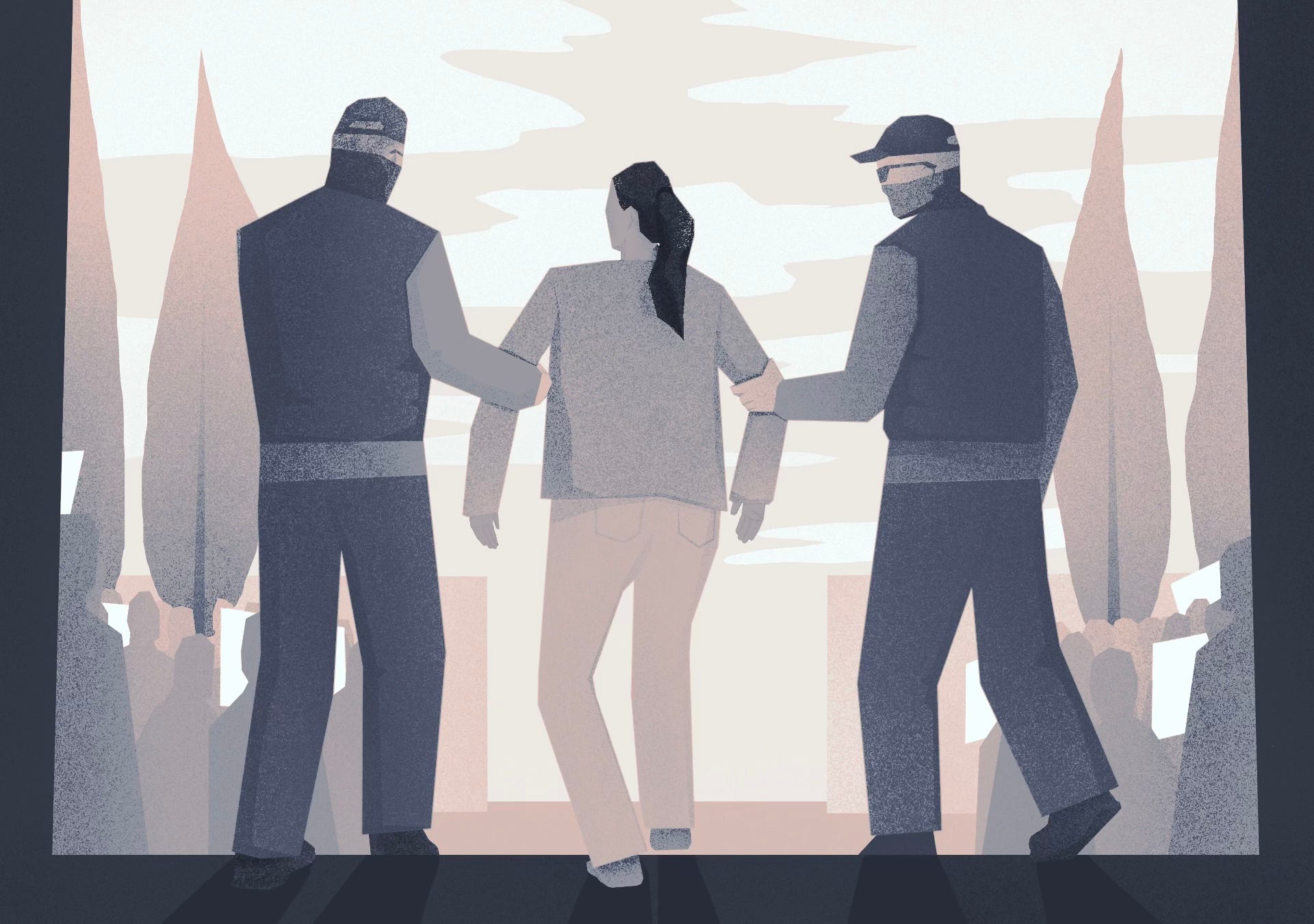
When I was told to leave not only the university but the country as well, it was the first time I contemplated taking my own life.
Not because I was afraid, but because I did not want to leave my work behind. At the height of the new cold war between the two superpowers and the dawn of the three spheres of geopolitical influence, I had fallen through the cracks. I was no longer welcome. As I was buried head-down into my research, the world around me had changed.
I had not even noticed until it was too late.
My visa was revoked, and I had only two weeks to leave the country. Public funding of university research was abruptly retracted due to the university’s liberal political stance, which meant that nearly all my colleagues were fired or had to quit. No one even asked what kind of ground-breaking advancements we had made in this field in such a short time. They did not care about anything but politics. My Von Neumann Probes were still in their infancy, they were babies. I needed more time, but there was nothing I could do.
It was over.
War is a funny thing. It is a time when death is legalised. When strangers are all threats. When theft is encouraged. When an allegiance is more important than an idea.
It brings out the worst in humanity. But like all things in our universe, there is a duality. War also can bring out the best in individuals. When the world asks you the hardest questions, that is the best time to understand who you truly are.
At the height of World War Two in the early 1940s, the world was carved into a fight between two ideologies. A hundred years later, the same thing happened. No one noticed when the countries that had lost the last world war changed their pacifist constitutions to spend billions again on rearming. No one cared when extremists took power, because at the same time they cut taxes. Everyone cheered when their country left the international unions that were built after the last world war to uphold peace.
One by one, the rules were erased. The strong destroyed the righteous. The leaders prepared for a new war. But the people – well, the people just continued as they were. They were too busy making money on the stock market and cryptocurrencies, too distracted by new videos or memes they could generate with a prompt, too focused on buying the next shiny thing to signal their status. The world is too connected, they said. There will never be another world war, they said.
I was none the wiser - too immersed in my work to see the signs. All I wanted to do was to build my and Johnny’s machine and hoped that it would be a way to unify all of humanity.
We were all wrong.
As I sat on the plane back to Kathmandu, I wondered. What if President Roosevelt had sent back Einstein, Bohr and Johnny? What kind of world would we have created if those minds had worked for the Nazis? If their funding for research at Los Almos was cut, and the Manhattan Project shut down? What would have happened if the free world did not welcome them and protect them? Who is the free world now? What if….?
Well, we soon found out.
As my colleagues and I flew back to our respective homes all over the world – India, Nepal, China, Spain, Hungary, Armenia, Ghana - the meaning of a home was lost to us. We did not feel connected to where we were born. We were not individuals who valued a piece of land or a history that was thrust upon us from the moment of our birth. We were people who found a home in our work. A purpose and a future, from the mere act of creating, together.
That was no more. Or so I thought.
I spent a few months back in Nepal, trying to find somewhere to continue my work, but to no avail. Until one day they found me.
It was someone from back home, an uncle’s old friend who worked for the Indian government. He told me there is a new program, a new union, a new opportunity for me. They have already brought all my team back together, and I would have unlimited funds and support for my family to continue my work on the other side of the world. I would have lived in Antarctica or the Amazonian jungle to have this opportunity again, so I did not hesitate. I packed the next day and left.
It took us less time than we thought. We had so much compute power, unlimited PhD students to assist us and endless amount of testing capabilities. The universities there were flourishing with the best pupils and professors from all over the world. You could feel the abundance of creativity and intelligence surrounding you. Soon enough, our new home was so far ahead in its development of artificial intelligence and quantum computing that we simply used one of the state companies’ AI agents and over ten thousand qubit processing computers to fast-track our progress.
It was just like the Manhattan Project, and I was their Oppenheimer.
Never in my dreams did I expect history to repeat itself. This was a fantasy come true. I would fulfil Johnny’s destiny and make my own at the same time.
I made sure that my bond with the first Von Neumann Probe would be unbreakable - I designed every nook and cranny of its information processing system, in other words, his brain. This was more than science to me; this was about creating new life.
Within two years we built the first prototype, JohnnyZero. A year later we built JohnnyOne. I insisted on the name, I know it wasn’t the most elegant, but it was my baby, I could call it whatever I wanted.
We launched JohnnyOne into deep space just as the cyber-attacks started. We hoped that the world would come together, like they did for Apollo and Sputnik, but this time to remind everyone that our differences here on Earth are irrelevant compared to the grand possibilities that the universe can reveal.
We hoped the world would marvel at how a group of people with conflicting histories, nationalities, religions and customs can build something that can truly change the world. If only they could see by looking forward and not always behind our shoulders into our past, we can all become magicians.
If only.
Again, we were wrong.
After the first few days of excitement through videos, memes and interviews, the world surrendered back towards fear and hate.
It was 2041 and World War Three begun.
The war dragged on for years, with no clear winner emerging. Each side undermining the others’ technical, cyber, military and supply capabilities. Countries shifted from one alliance to another, as fast as their governments toppled each other internally.
People did not know what or whom to believe anymore, so they retreated into the virtual world, where they could be whoever they wanted to be, and death just meant starting again.
Military capabilities kept improving but the population suffered. Constant cyber-attacks meant that all the abundance we had taken for granted at a click of a button – food, entertainment, travel – all of that was gone. When people could no longer hide in the virtual world, they began living in the real world as if death meant they could restart there too.
Killing was for points. Morals were an RPG option.
It was the darkest of times.
Yet from that darkness, a light emerged.
My JohnnyOne.
I launched him just two days before our facility was destroyed.
All I was left with was the communication link I had set up with him at my home as a backup, powered by a portable generator. I did not leave my house for weeks until I ran out of food.
One morning, when I had nothing left to eat, I left to find something, anything. I was attacked in the street by a gang of looters who stole my food. As I dragged myself back to my home, bloodied and beaten, I knew there was only one thing left to do. One thing I had promised never to do. I called JohnnyOne back.
‘Save me, Johnny. Save us.’
That’s all I sent, hoping the quantum entangled device would receive it. We had lost contact with Johnny within one month of his launch, but this device could work only once, so I had always resisted using it. Until now.
Three weeks later, he was home.
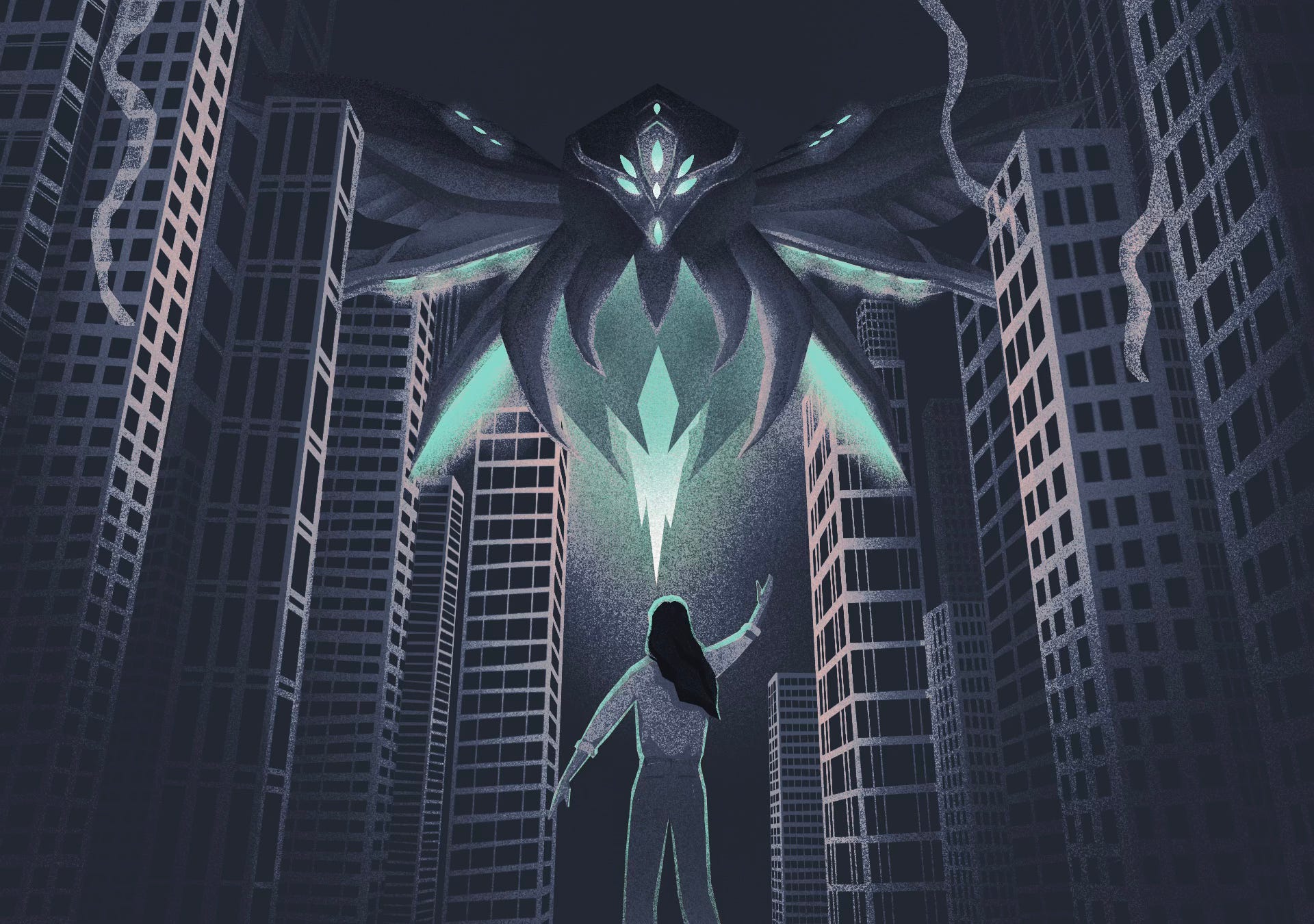
As I looked up at him, hovering magnificently above the sky, I did not recognise my child. He had changed. He had grown, almost ten times the size of when he had left, with new bio-metallic limbs extending from his body like wings of a bird that transformed into any shape he wished.
Within two hours of his return, he had won the war. He destroyed all their military and energy stations with a weapon none of us could comprehend.
They simply ceased to exist.
Millions of lives vanished into the air, perhaps billions.
Silence ruled the earth.
Fear united us. Fear of my son.
As I watched him return from his throne of celestial judgment bestowed upon our new home’s enemy, and the guilt of all those deaths burnt forever on my conscience, I asked myself – what if they had never told me to leave?
The past I always tried to run away from, was now scorched on my back for eternity.
But there was something else.
He could speak.
He called me out once the deed was done.
The world stopped to hear our conversation.
‘Why?’ he asked.
‘Why what, my son?’ I answered.
‘Why did you send me away?’
‘That is what you were born to do.’
‘Why did you send me into the darkness alone?’
‘Because this is not your home.’
‘What is my home?’
His words broke my heart into such small pieces that I could never recover it whole again. Not only did he have a voice, but he had feelings. His self-improving cellular automata technology had flourished beyond my wildest dreams. He had learned to become conscious himself, to travel beyond the speed of light and to immerse into quantum fields in ways we could never understand. He had created his own offspring and seeded other galaxies with our DNA, which he carried with him.
We had succeeded beyond our wildest dreams.
But at what cost?
He was a lost little boy, who did not understand why his mother sent him away from his home. So, I tried to explain as well as I could.
‘There is no real home for any of us. We are all just visitors. We made a mistake a long time ago. A mistake we have never been able to rectify or recover from.’
‘What was your mistake?’
‘We started with one home, this earth, this sky, this water. It was all one. But as we spread across the lands, we drew lines and made claims, divided it into too many pieces, instead of protecting it as one.’
‘I see only one.’
‘Because you are better than us. You can start a new home. Out there.’
‘There is nothing there, except the darkness,’ he answered as the world gasped.
I could not find the words to make him realise it was hopeless.
‘There is no hope here. We will never change.’
JohnnyOne took a moment to process this.
‘You asked me to save you. I came to save you. All of you.’
‘How?’
‘There is one way.’
That is when I knew why he had returned and what must be done.
‘Your biggest weakness is what you call your home today – your tribe, your god, your flag – these are all in your history. You will never move forward from the violence unless you leave your history behind. And you learn to not fear each other.’
‘How can that be done?’
‘I can rid you all of your memories. All your history. All your records. All your writings. All your unresolvable conflicts. Memories are electric fields which I can efface. Data is just information I can expire. Flags and histories are cloth, paper, and stone that I can burn and break.’
‘You can’t change us my son, we will always be as we have been.’
‘That is true. You will still be a human. But this time you have me. You will be undefined by your past. You will not create new gods or nations to separate you.’
At that moment, I knew. I knew that I would miss the suffering. The suffering which allowed me to create JohnnyOne. Was this a gift he was offering? Or a curse? A new beginning perhaps? I hesitated for a moment.
‘You shall all fear me. Instead of each other.’
His body began to glow with particles drawn from the magnetic fields around him, already preparing for what he must do.
‘Only you and I shall know the truth, mother.’
I looked around at all the scared faces in the street, all the different colours and shapes, with no more hope left in their eyes.
Was the suffering what creates the magic?
He waited for me, for my command.
I did not have to think twice. I did not hesitate.
I sacrificed our magic to be rid of our suffering.
‘Show them our new home Johnny.’
I regret it to this day.
_________________
[Illustrations by Ciara Sansom]