Birth
A Christmas Special

Christmas, in its deepest symbolic meaning, is not merely about the birth of a historical figure but about the arrival of light from darkness.
In Christian theology, Christ is literally called the light of the world.
Christmas also sits just after the winter solstice, the darkest point of the year, when light begins to return. The (re)birth of light.
Scientific ‘light’ in the early universe was very literal. For around 380,000 years after the Big Bang, the universe was an opaque plasma. When protons and electrons combined into neutral atoms, photons were finally freed — light came forth from darkness and the universe became transparent. That first cosmic light is still around us today, as Cosmic Microwave Background Radiation [see image below].
The Big Bang is the original Christmas in a way — the birth of all light, all structure, all possibility.
A universe that evolved from no space and no time, to expansion, heat, energy, and finally to the first release of light. From this darkness, the first atoms formed and with it stars, planets, biology, consciousness, love.
Birth as a universal concept, is the evolution of light.
Christmas reenacts this origin myth symbolically: one small point of light arrives in the form of Christ, and from it, new meaning radiates across the world.
This light does not stop there. It remains with us at the moment of our birth, and even our death.
When a sperm enters an egg, scientists actually observe a burst of zinc-induced bioluminescence — a microscopic flash. It is not ‘light’ in a mystical sense, but a chemical spark signalling fertilisation.
From darkness, a spark. From a spark, a symbiosis. From symbiosis, a form, and eventually a mind capable of generating its own subjective light — consciousness.
Every human being begins as a cosmic micro-Big Bang. A singularity of light that expands, differentiates, and self-organises.
Every human being also ends as a cosmic micro-supernova.
When a massive star dies in a supernova, it explodes, blasting its outer layers into space and leaving behind a super-dense core that becomes either a neutron star or, if massive enough, a black hole, while the ejected material forms a beautiful, expanding nebula, seeding the universe with heavy elements crucial for new stars, planets, and life.
When a person dies, measurable electrical activity in the brain ceases. The ‘light’ of the mind — synchronised oscillations, gamma bursts, neuronal firing — falls silent, but not without a last hurrah.
Multiple studies (in humans, rats, and other mammals) have shown that an unexpected spike in high-frequency gamma waves occur at the moment of clinical death. This could be the brain’s last attempt to clutch on to memories, narratives or other forms of conscious perception as oxygen is depleted. Or it could be the release of the light. A supernova of our soul that rejoining a nebula of consciousness. Not a death, but a return.
Matter and energy don’t disappear—they are always held constant in our universe, as the laws of thermodynamics dictate, evolving from one state to another. Just as the early universe’s plasma recombined to release light, the dying brain’s complexity dissolves back into the cosmos to release our light back to its original home.
Light emerges. Light diversifies. Light organises into a world. Light returns.
You can call this the power of entropy from the Big Bang, or you can call this God, or Christ if you need to give it a human form.
Ultimately it is light. We are made of this light and are a part of this original light, before our birth and after our death.
At this time of the year I tend not to think of historical figures or religious concepts or even the science behind creation. We cannot experience the full spectrum of reality and hence the true nature of light, and we do not have the language to express it in its honest form. Therefore, we are merely left with acknowledgment.
Instead, I prefer to simply think of light itself as the purest process of creativity—how it is reborn in so many beautiful ways. One that is not contained by our perception of a beginning or an end. One that simply is.
And how lucky we are to be a small part of it.
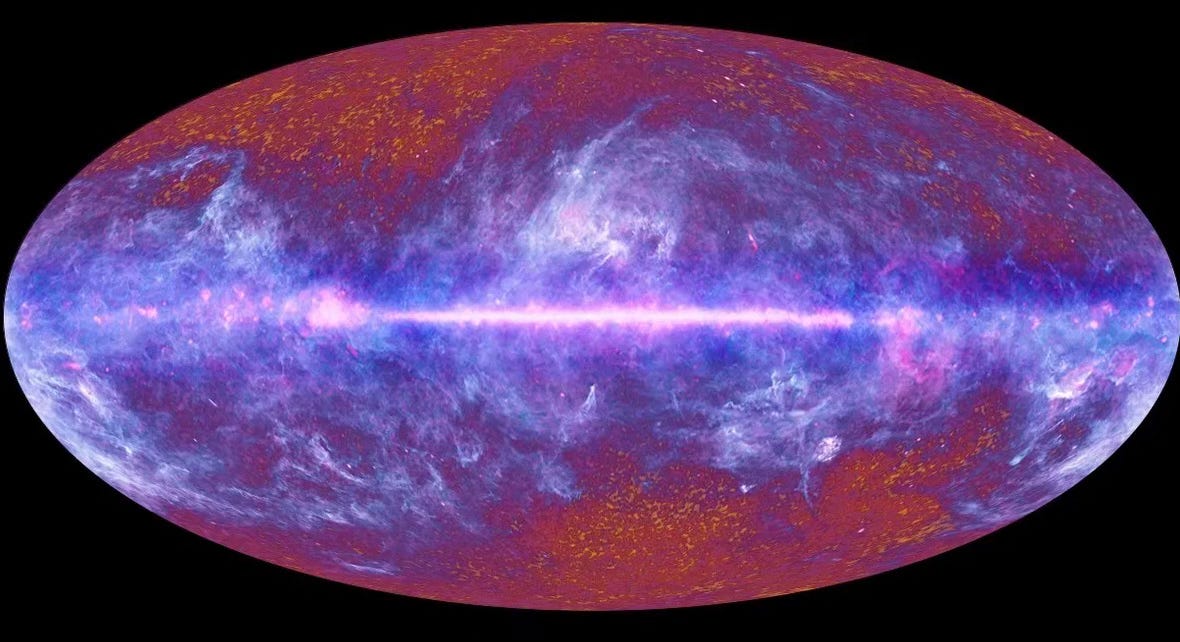
[All-sky image of cosmic microwave background from data collected by the European Space Agency’s Planck satellite showing echoes of the Big Bang left from the dawn of the universe.]
Next week will be my final Substack in the LIGHT series, after which I will explore 'lighter' themes, pun intended.
Merry Christmas 🎄.
Your thoughts astonish me; they are nothing short of extraordinary.👍